Saturday, 7 March 2020

Creative Summer Holiday Ideas

6 weeks holiday is a long time when you have active toddlers, even if they don't attend school most weekly activities, Toddler Groups, Tumble Tots....etc. tend to stop during the holidays so here are some creative ideas to keep your children happy and busy...they might learn some useful skills too!
But first a health warning!

Introduce a Colour Themed Day with the kids. Lets try GREEN. Tell the children when they get up that they are going to have a green day (or what ever colour you fancy) Use your creative skills to make the day as exciting as you can.
  • Serve green milk with their cereal (add a little food colouring to normal milk)
  • Give a selection of green foods for lunch, tea and snacks
  • Choose green clothes for them to wear (don't forget you need to join in)
  • Do some green cooking...green cakes with green icing, green jelly, apple pie, avocado dips
  • Play with green play dough
  • Go for a walk in the park and search for different shades of green (use paint sample charts from the local DIY store to match different greens in the park)
  • Make a green collage using a variety of materials e.g. buttons, paper, card, tissue paper, magazine pictures.
  • Play with green balloons
  • Paint a green picture
  • Photograph green things such as doors, curtains, toys.
  • Read Green Eggs and Ham at bedtime
Next time let your children choose the colour and let them suggest activities.

Holiday Canvas Creation
This is an idea I have stolen from my daughter Sally who lives in Brisbane, Australia. She bought a cheap blank canvas from their version of Wilko's and together, her and Clara, who is 3 years old are creating a personalized collage of all things Clara loves. She has begun by Clara doing some very sparkly hand prints using glue and glitter, then she has added shells collected on their trips to the beach, some photos of Clara favourite places, pictures of her favourite animals...kangaroos and possums! Her favourite Disney characters are next to be included in the canvas...it is a work in progress and I'll let you see the finished masterpiece when it's ready. What a great idea....perhaps you and your children could create your own canvas of things you do during the summer or simply your favourite things.

Have you ever made a holiday scrapbook? When my girls were little we often made scrapbooks over the summer cutting and sticking memorabilia including leaflets, admission tickets, postcards...that shows my age! Photos, bits of nature like shells, leaves and flowers. We wrote captions...nothing too taxing as it was for fun and they were all stuck into a cheap scrapbook to remind us of our summer...it's great to look back and talk about those special times.

Summer Memories Box
This year I have decorated a memories box for my grand daughter so she can saw bits and bobs that will help her remember summer 2017. I have personalize it by decorated it using pictures, photos and embellishments. I have covered up the faces of her holiday friends because I have not sought permission to use their photos on a social media site.


Image result for inspirational sayings about children's creativity


Collections
Making a simple collection can be fun and it gives purpose to trips out. Look at the blog section on collections for some ideas.

Be prepared
Before the holidays begin start to collect ideas and resources to keep the children busy. Buy some cheap colouring books, scrap books and paper, some new crayons...always so much nicer than old ones! Go to the charity shop and stock up on some age appropriate games. Make sure you have scissors, glue and sticky tape. I spotted some coloured masking tape this week that will be great for big junk modelling...oh yes and collect empty cartons, plastic bottles, shiny paper etc. for creating masterpieces.
I store my creative resources in an IKEA trolley, it's handy...being on wheels and all the resources are on view so self selection is easy.


Tuff Spots
Have you come across builders trays from the local DIY shop...better known as Tuff Spots in Nursery/Infant classes.  They can be used as sand trays, messy trays, mud pie trays, builders yards, dinosaur lands...the list is endless when you need some way of keeping play contained. Look at my separate blog on Tuff Spots.
Tuff Spots are made of sturdy plastic...sit nicely on the floor and toddlers like to sit around it or in it to play...it really is one of the best things you could buy for the garden. The flat bottom and raised sides means children can play with dry or wet materials, and best of all they can create their own imaginary worlds in them. You can create a mini building site in your builders tray just by adding some sand, stones and toy building trucks.  
                                                                 
                                                                    Invitation to play
Something I have always done when my own children were little and now when I am expecting my 4 year old grand daughter for the day I set up simple play spaces with some interesting resources which I hope will capture her imagination. The resources should instantly capture the imagination, making sure the possibilities are open ended because you can be sure, if she doesn't have choice she will reject my ideas e.g. if I put play dough out with rolling pins and cutters she will walk in and decide she wants to bake instead! I have found it better to put out a basket of play things so she has choice and an opportunity to explore the options first.
You really want to intrigue your child, giving them room to be creative, think creatively and explore creatively. Have on hand the materials you need, it's worth stocking up before the holidays with safe scissors, glue sticks, stronger PVA glue, scraps for collage, different pens, pencils and crayons, washable felt tips.
IKEA do an amazing portable storage trolley that I use for all Honey's crafty things.

Back to the 'invitation to play' I often use baskets, pretty boxes or trays to display the resources and if the resources lend themselves to creating an imaginative play area for dolls etc. I include pieces of fabric to help create a landscape or backdrop for the stories she likes to create. Children love tactile fabrics that can be draped and shaped. I have been looking for an unbreakable mirror that I can use for a play surface...that would add another dimension to the play! If you spot one at a reasonable price please let me know.
                                 Here are some ideas for creative invitations to play.
  • A basket of pebbles and seashells, a sand tray and some little figures (play people boats etc.)
  • A selection of fabrics, some clothes pegs and a clothes air horse...couple with two dining chairs and you have the makings of an amazing den! But expect it to be filled with cushions, toys, snacks and books gradually throughout the day.
  • Brown and green fabric, boxes to create a landscape and a box of dinosaurs. (small world play)
  • Sparkly, shiny fabric (sequin fabric is wonderful) shiny stones, bits of wood and some little fairy dolls can begin a fairy tale grotto. I have acquired, from car boot sales, some wooden mushrooms which fits beautifully with the theme. A few big stones, some flowers from the garden and some wood for roofs and you have hours of fun ahead of you. (small world play)
Other ideas for small world play are: Troll Forest, Reptile World, Mini Beast World, Under The Sea, Down on the Farm, On the Moon, Outer Space, Our Town, The Building Site, Arctic World, The Rain Forest, Snowy Day, At the Beach, Growing, Spring, Autumn, Winter, Christmas, The Easter Story, Harry Potter, We're Going on a Bear Hunt....to name but a few!

If the activity is a success it's worth hanging on to the props so your child can re-visit the experience and build on it. Recently I purchased a Simplicity dress pattern book...one of the enormous ones for £2.00 and left it, strategically placed, along with some safe scissors, scrap paper and a glue stick and it soon became Honey's favourite activity...she has even had to take scissors on holiday with her because she just now loves cutting out! What's more she has become an expert with those little scissors!  

An invitation to play
Under the purple sequin fabric hides a basket with 3 soft toy fairies inside all ready for an adventure with the witch from Room on the Broom by Julia Dolnaldson.

Monday, 2 March 2020

Hand made multisensory learning resources

Image result for inspirational sayings about children's creativity

As you will have gathered I love making resources especially if I can use fabrics.
Whilst you have some time on your hands ....
Here are some more ideas
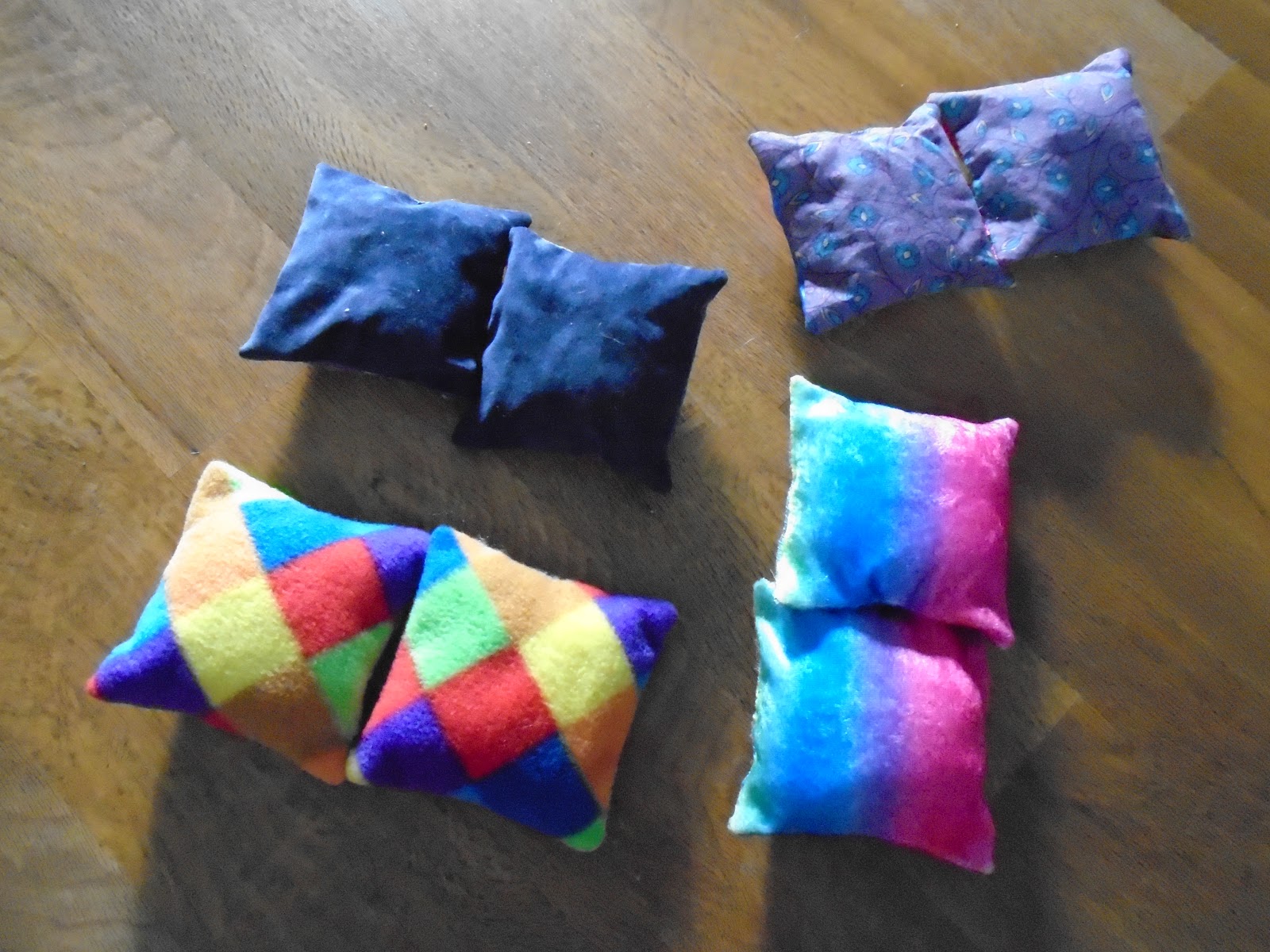
A set of tactile mini cushions

These cushions are simple to make using scraps of different fabrics and can be used for a variety of activities with babies, toddlers and young children.
If you use the same fabric on one side and two of each different fabric on the other side you can do matching pairs games.


If you ensure the mini cushions have different textures, furry, satin, woolly, leathery, flannel, bobbly and there are 2 of each you can play a finding game putting the matching cushion under a cloth...feel the your sense of touch.

Use the mini cushions in a treasure basket for babies
Because the mini cushions are made of different fabrics with different textures lots of new language can be introduced as children explore them. Don't forget to have fun too...because they are filled with cushion stuffing they are light and safe and can be chewed, thrown and sucked! Try using them with a big piece of fabric or parachute and bounce them up into the air!
To engage the other senses you I often add sound inside the cushions including squeakers, rattles, crunchy sounds using crinkly paper. I also sometimes include smells using scented oils and dried herbs.
Different shaped pillows can match a theme for example I created lots of heart shaped pillows in a treasure basket for Messy Church on Valentines Day.
If you want some mini sensory cushions making I am happy to give you a quote and take orders...just message me with contact details.  
No automatic alt text available.
Treasure bottles...like this Frozen inspired one are great for babies and toddlers.
For babies I would seal the bottle so they just look, shake and explore, but for toddlers who
no longer put everything in their mouths I would let them open the bottle and explore taking
the objects out, sorting and exploring them and putting them back in over and over again.

 August 2017 Messy Church theme is water and I have created a magnetic fishing game  for the children to play with. It all fits on the sea mat I have made and each sea creature has a hidden magnet. A strong magnet on a fishing rod completes the game.

When I was thinking through maths activities for my blog and I came up with a collaged canvas with lots of pictures and numbers to explore. It took me an evening to make and I used a couple of old children's books, some magazines, Mod Podge glue (which I love), and some sharp scissors.


 I made a banner for a friend and had some triangles left so I made a banner number line for a child's bedroom or play area.


Her is an example of a topic starter pack I supplied for a local special school. They are ideal for early years settings and start at as little as £50. It is a multi sensory resource that can be used again and again. All of my resources are ideal for young children and for children who need beautiful tactile, multi sensory learning resources. Can you tell I have fun putting them together!
I enjoy creating bespoke Fidget Blankets for the elderly and for people suffering from dementia.


This is an example of a multi sensory treasure basket I created for a special school. It is based upon the story of The Very Hungry Caterpillar.


Story sacks are a lovely resource to engage young children and have elements that are multi sensory including a themed treasure bottle.

Here is a winter themed story sack I created last year.


Twinkle Twinkle Little Star story sack


A handmade multi sensory blanket with sensory pillows, some with lavender,
some with sounds and some with taggy ribbons...good to chew!
The blanket includes taggy ribbons, mirror, pocket and toy, hidden squeeker, and a variety
of fabric textures.

Messy Church at St Mary's Eastwood

Messy Church at St. Mary's has sadly been placed on hold until the Corona Virus Crisis is over.

Wednesday, 19 February 2020

Creative Maths

Maths seems to be something that scares a lot of people..."I'm no good at maths" is the comment I hear so often and children soon pick up this attitude if they hear it. Early years maths can be so much fun and the most natural thing in the world. A good start can make such a difference to your child's maths confidence. Here are some age appropriate activities that you and your children can have fun with. I have split it up into sections based upon age and you might find it helpful but look at the age above and below activities because children develop at different rates and also need to revisit learnt things to embed them.

0 to 1 years
Research has shown that babies absorb information in order to make sense of the world around them so it is never too young to start introducing maths concepts...sound strange? It's really simple...
  • Sing to baby...sing all the old favourite nursery rhymes...rocking and bouncing your baby as you sing. Look at www.nurseryrhymes.org for a list.
  • Use treasure baskets containing different objects to explore such as natural objects, spoons, keys, blocks, scarves, musical instruments etc. (click on the treasure baskets label for some ideas)
  • Play hiding and peep-bo games, hiding toys under a blanket etc.
  • Include counting and mathematical words as you talk to baby.


   1 year to 2 years
  • Matching one for you and one for me (picnics)
  • Counting whenever you can in real life situations e.g. climbing the stairs, counting steps as they begin to walk, counting out food, toys.
  • Matching pairs...young children love to shout "snap" and they quickly learn what it means.
  • Sorting collections finding the same and different. I keep sorting objects in jars and zip bags ready to hand when needed. Some sorting objects become favourites like wild animal packs, dinosaurs, cartoon characters, buttons, natural objects like shells or pebbles. HEALTH WARNING...never leave young children alone with small objects that can be swallowed.
  • Keep singing and introduce number rhymes such as 5 little speckled frogs, 5 little monkeys, two little dicky birds etc. I use toys to help with number songs, collecting characters from charity shops and car boots. Children learn better when they can handle the objects, moving them and re-enacting the song, or they become the characters and hop about!
  • Share books that feature counting and other maths concepts such as sorting, same and different, shapes and comparing size.
  • Playing with 3 dimensional shapes and containers, building and knocking down, filling and emptying  and sorting.    
  • Everyday brings opportunities for toddlers to learn bout  numbers, counting, recognising shapes, sorting and matching.
                                                                      2 to 3 years
  • Finger rhymes using fingers / finger puppets...rhymes such as Tommy Thumb, 12345 once I caught a fish alive
  • Introducing more and less at meal times
  • Sorting by size using traditional stories like Goldilocks and the three bears and sorting the washing from the clothes basket ...who's are these knickers?!
  • Hide and seek to explore position...under, over, behind, inside, outside...
  • Play dough can create a myriad of opportunities to talk and explore maths concepts...large, small pieces, shapes cutters, filling containers, heaviest and lightest, creating numbers with play dough, sharing...the list goes on and on.
  • Explore interesting objects using treasure baskets and mystery boxes and bags...introduce a magnifying glass and slip some tactile numbers in too!
  • Boxes are amazing...have you ever read 'My cat likes to hide in boxes'? Look at all different containers, how they open and close, what they contain, how much 'stuff' you need to fill the box?
  • Send your toddler off to get 2 spoons, 3 biscuits ...multiple of things to see if they are beginning to understand 1 to 1 correspondence. And start to introduce adding 1 and taking 1 away.
  • Make sure numbers 1 to 10 are visible around the house so your toddlers gets used to them. Point them out counting to 10 and use them in number songs and rhymes.
 A 1 to 10 banner for the bedroom or play area at home


This is a canvas I made simply by cutting and sticking counting pictures and numbers. It makes a lovely activity that can be often revisited, searching for different things to count and talk about. If you hang it on the wall make sure it is low enough to touch as counting includes touching.
3 to 4 years
  • Use 3 dimensional shapes to create junk models so they can begin to explore what shapes build, balance, stack, how many faces? Continue to explore different and new objects looking at their shapes, size, what they are made of, how much they weigh etc.
  • Create obstacle courses outside or, if you are brave, in the lounge to explore positional language...under, over, through, round, in etc.
  • Search for numbers in the environment, on houses, car number plates etc. Use numbers to label things and have card / wooden numbers to handle and play with. Colour in numbers, cover numbers with play dough or collage materials, discuss their favourite number.
  • Money play creating shops and café role play situations and experience real money through shopping and cafe's. We have a coin bottle for all our loose change and my grand daughter loves to help fill it from my purse. Do coin rubbings.
  • Begin to introduce games where counting can be used such as hop scotch and what time is it Mr Wolf?
  • Expand on simple adding and subtracting...how many more do you need?
  • Counting songs and rhymes up to 10.
  • Counting numbers of objects, introducing moving objects from one place to another as you count.
  • Sharing to make it fair...one for me, one for you...count to make sure it's fair.
  • Go on a shape sort in the environment...it's great when you fine triangles! (circle, square, oblong, triangle to begin with)
  • Make sure solid shape names are used where appropriate...a cube is not a square...it has square faces. A ball is a sphere not a circle.
  • Weighing and measuring can be explored when baking, cooking and crafting.
  • Look for stories involving maths concepts such as Handa's Surprise by Eileen Brown when each type of fruit gradually disappears. The three bears have 3 bowls, 3 chairs and 3 beds.
 Finding numbers in the oats


Find the number treasure bottle


                                                                          4 to 5years
  • Find big numbers in the environment   
  • Collect lots of things and count them such as marbles, bottle tops, buttons, shells, fir cones...introducing number over 10
  • Share shopping experiences letting them pay the shop assistant
  • Cooking letting them weigh the ingredients
  • Begin to introduce time linked to clocks and develop an understanding of the measurement of time including days, weeks, months, years, calendars, timetables etc.
  • Explore further shapes in the environment
  • Look for numbers everywhere and explore the use of numbers
  • Explore addition and subtraction and multiples of things...counting in 2's, 5's and 10's
  • Play dice games and learn to move forward, backwards and doubles. Recognising how the dice spots form patterns  that can be recognised at a glance.
  • Other games including card games, skittles and safe darts.
  • Encourage your child to estimate how many before they count...it helps later when dealing with bigger numbers and making sensible guesses.
  • Finding objects using simple directions
  • Sorting objects by how many legs, arms, eyes, toes etc. and putting things into sets because of their qualities....put all the creatures with 4 legs in one group and the rest in another group.

Sunday, 9 February 2020

Small World Play


Small world play is quite simply when children play using dolls, figures and small versions of the real thing to create their own little worlds and scenarios...exploring creatively real and fantasy worlds.
Small world play is such an important aspect of children’s play because it helps children develop in so many different ways. When children play imaginatively it enables them to express thoughts and experiences in their play helping them explore the world in which they live and begin to make sense of it. Small world also offers the opportunity for children to build on their language skills, expanding their vocabulary and their understanding. This type of play not only supports a range of areas for development, but also benefits the child’s independent play skills.
As parents /grand parents /carers we can help this learning process by providing the tools for children to use small world play to learn and develop. We can give children space to explore and support their learning by playing along side them at times, modelling language and expanding on their ideas but the important thing is to let them take the lead and explore, invent and create independently.

Imagination

Children use their own experiences of the world to build on their imaginative skills. Small world play offers the opportunity for children to act out these experiences in a controlled way. Small world environments allow children to act out daily routines or past events such as putting a doll to bed or driving a car, however it also allows them to experiment with fantasy play and develop their own ideas

Building Language Skills


Small world helps children develop their language skills including building vocabulary and understanding. Children are able to learn new words and practise using them in context. Expressive language skills can be encouraged through a small world experience, allowing the child to narrate their play and talk about what is happening. They learn how to use positional language in this type of play, as a child moves the people in, on and under objects.
Problem Solving Skills and Cause and Effect
Problem solving skills are key due to the nature of the play. Scenarios can often change and adapt, enabling the child to think of new ideas or ways to extend the play. Resources are a range of sizes and scales meaning a doll may not fit into a small world car. This can lead a child to display a range of emotions and use their problem solving skills to fix the problem and continue the play successfully.
Children will often learn a great deal about cause and effect through small world as they have a great deal of control over the play. This allows them to experiment with different actions, leading them to understand different outcomes. This allows a safe environment for the children to practise cause and effect without getting hurt!

Themes for small world play: 
Fairy Forest, Dinosaur World, Troll Forest, Reptile World, Mini Beast World, Under The Sea, Down on the Farm, On the Moon, Outer Space, Our Town, The Building Site, Arctic World, The Rain Forest, Snowy Day, At the Beach, Growing, Spring, Autumn, Winter, Christmas, The Easter Story, Harry Potter, We're Going on a Bear Hunt....to name but a few!

Creating a space for Small World Play
Tuff spots (builders trays) are great as they are large and form an arena. I have made a number of themed play mats to fit the tuff spot. Here is a sea inspired tuff spot mat.


 Play mats can help to keep the play confined to an area.

Just fabric drapes can also be used and choosing fabrics carefully you can enhance the play...shiny, sparkly fabrics, rough landscape patterned fabrics, grass effect fabric can all be found in charity shops or car boot sales. I have a contact who works at a clothing company who kindly lets me have samples of the most beautiful and unusual fabrics.

As well as fabric you can make available small boxes, stones, shiny pebbles, bits of wood etc. for your child to create a landscape for their small world play...get them to search for things too.        

 Image result for inspirational sayings about children's creativity

Sunday, 2 February 2020

Celebration Tree

I love the idea of having a celebration tree at home right through the year that can be decorated at intervals by the children, or adults as a celebration of the different seasons and events throughout the year...Christmas / Epiphany/ Winter / Spring / Summer / Autumn / Easter / Mothering Sunday & Father's Day / Holidays / Birthdays / New Births. Celebrations are important, they help us focus on good times and encourages us to be thankful.

This tree is decorated with stars and snowflakes for the Winter.


The same tree becomes a Spring tree covered in silk blossom
 and sporting some clip on birds from Lidl


By adding some little Easter eggs I have made my Celebration Tree into an Easter Celebration Tree!  All ready for Easter Sunday! 

Sunday, 24 February 2019

Creation in all it's glory!

We focused on the creation story in Messy Church in Feb 2019 and here are some of the activities we enjoyed.

In the beginning there was nothing so I introduced cornflour with water and green  jelly bath


Day one there was light...actually we had plastic battery 
candles and some decorative tiles


Making junk animals and decorating a world with photographs of the natural world.


Birds of the air and fish of the sea


                                                                                            Thomas is helping his friends plant seeds